Home

The 14 Stations of the Cross

A complete guide to the Via Crucis with the prayers and meditations of St. Alphonsus Liguori, public domain masterwork art, and the full text of the Stabat Mater.

What Are the Stations of the Cross?

The Stations of the Cross (Latin: Via Crucis, also called the Way of the Cross, Way of Sorrows, or Via Dolorosa) are a series of 14 images depicting Jesus Christ on the day of His crucifixion. The devotion is a mini-pilgrimage: the faithful move from station to station, pausing at each to meditate on a specific event from Christ's Passion and death.

The devotion originated in Jerusalem, where early Christians retraced the path Jesus walked from Pontius Pilate's judgment hall to His burial tomb. The Franciscan Order, appointed custodians of the Holy Land in 1342, brought the practice to churches across Europe. Pope Clement XII fixed the number at 14 in 1731, and today the Stations can be found in virtually every Catholic church in the world.

The Stations are prayed throughout the year but are especially associated with Fridays during Lent and Good Friday. A plenary indulgence is granted to those who piously make the Way of the Cross.

Pray the Stations online with audio

Full prayers, meditations, Stabat Mater, and narrated audio. Free.

Begin the Stations

Preparatory Prayer

The Way of the Cross is a devotion to the Sacred Passion, in which we accompany, in spirit, our Blessed Lord in His sorrowful journey from the house of Pilate to Calvary, and recall to mind, with sorrow and love, all that took place from the time when He was condemned to death to His being laid in the tomb.

My Lord Jesus Christ, You have made this journey to die for me with love unutterable, and I have so many times unworthily abandoned You; but now I love You with my whole heart, and because I love You, I repent sincerely for having ever offended You. Pardon me, my God, and permit me to accompany You on this journey. You go to die for love of me; I wish also, my beloved Redeemer, to die for love of You. My Jesus, I will live and die always united to You.
I

Station I

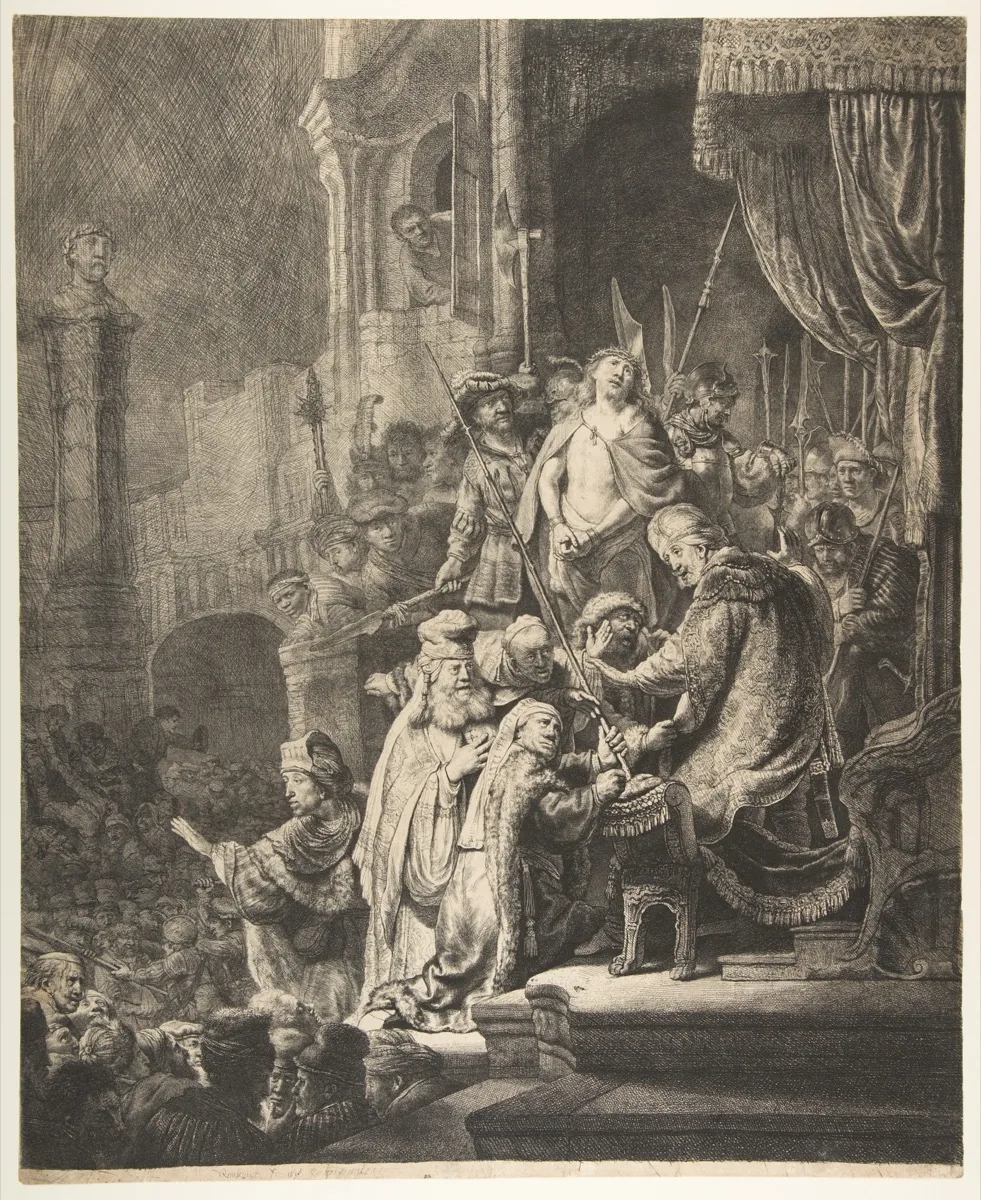
Jesus Is Condemned to Death

Station 1: Jesus is condemned to death - Rembrandt etching of Christ before Pilate
Christ Before Pilate: the large plate by Rembrandt van Rijn, 1636. Etching. Metropolitan Museum of Art (Public Domain / CC0)

Matthew 27:22-26; Mark 15:12-15; Luke 23:20-25; John 19:13-16

V.We adore You, O Christ, and we bless You.

R.Because by Your holy Cross You have redeemed the world.

Consider

Consider how Jesus, after having been scourged and crowned with thorns, was unjustly condemned by Pilate to die on the Cross.

Prayer

My Jesus, it was not Pilate, no, it was my sins that condemned You to die. I beg You, by the merits of this sorrowful journey, to assist my soul in its journey toward eternity. I love You, my beloved Jesus; I love You more than myself; I repent with my whole heart for having offended You. Never permit me to separate myself from You again. Grant that I may love You always; and then do with me what You will.

Our Father. Hail Mary. Glory be to the Father.

Stabat Mater

Stabat Mater dolorosa Iuxta crucem lacrimosa, Dum pendebat Filius.

At the Cross her station keeping, Stood the mournful Mother weeping, Close to Jesus to the last.

Read full meditation for Station I
II

Station II

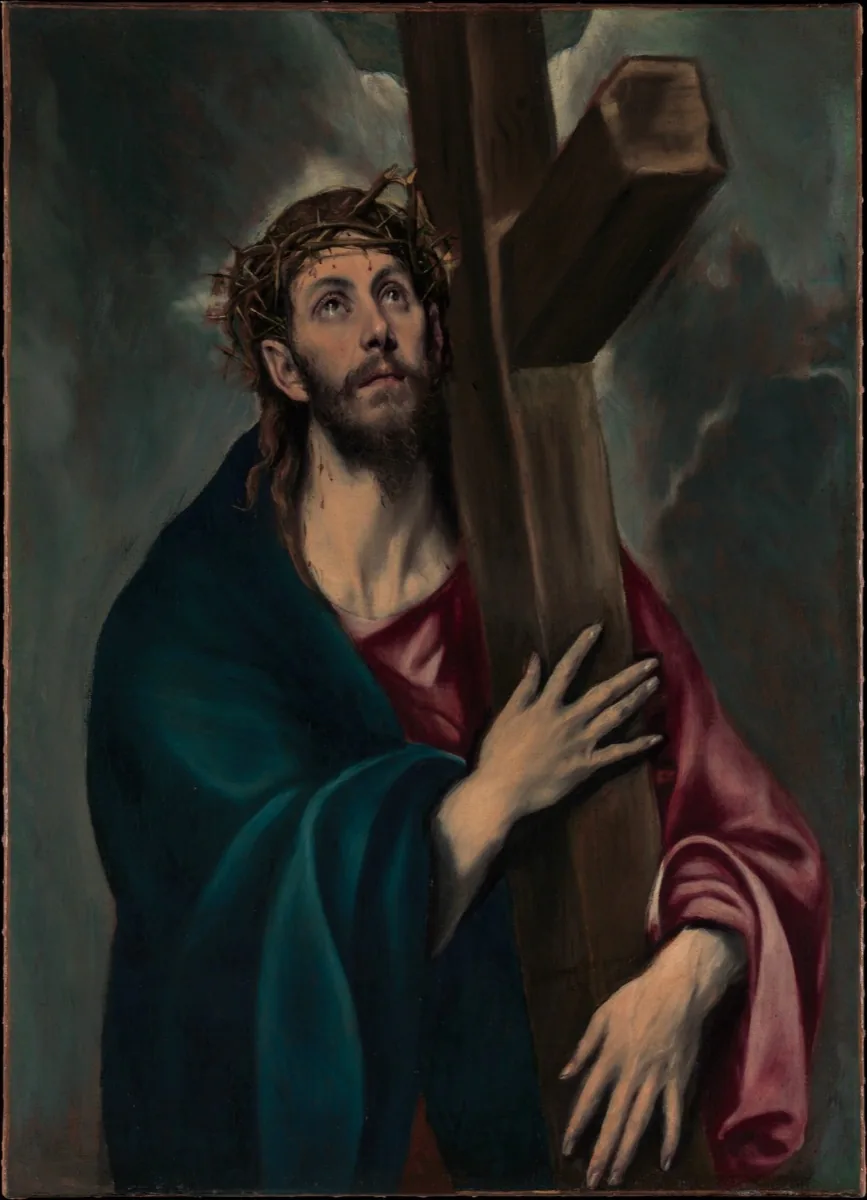
Jesus Carries His Cross

Station 2: Jesus carries His cross - El Greco painting of Christ carrying the cross
Christ Carrying the Cross by El Greco, ca. 1577-87. Oil on canvas. Metropolitan Museum of Art (Public Domain / CC0)

John 19:17

V.We adore You, O Christ, and we bless You.

R.Because by Your holy Cross You have redeemed the world.

Consider

Consider how Jesus, in making this journey with the Cross on His shoulders, thought of us, and for us offered to His Father the death He was about to undergo.

Prayer

My beloved Jesus, I embrace all the tribulations You have destined for me until death. I beg You, by the merits of the pain You suffered in carrying Your Cross, to give me the necessary help to carry mine with perfect patience and resignation. I love You, Jesus my love; I repent of having offended You. Never permit me to separate myself from You again. Grant that I may love You always; and then do with me what You will.

Our Father. Hail Mary. Glory be to the Father.

Stabat Mater

Cuius animam gementem, Contristatam et dolentem, Pertransivit gladius.

Through her heart, His sorrow sharing, All His bitter anguish bearing, Lo! the piercing sword had passed!

Read full meditation for Station II
III

Station III

Jesus Falls the First Time

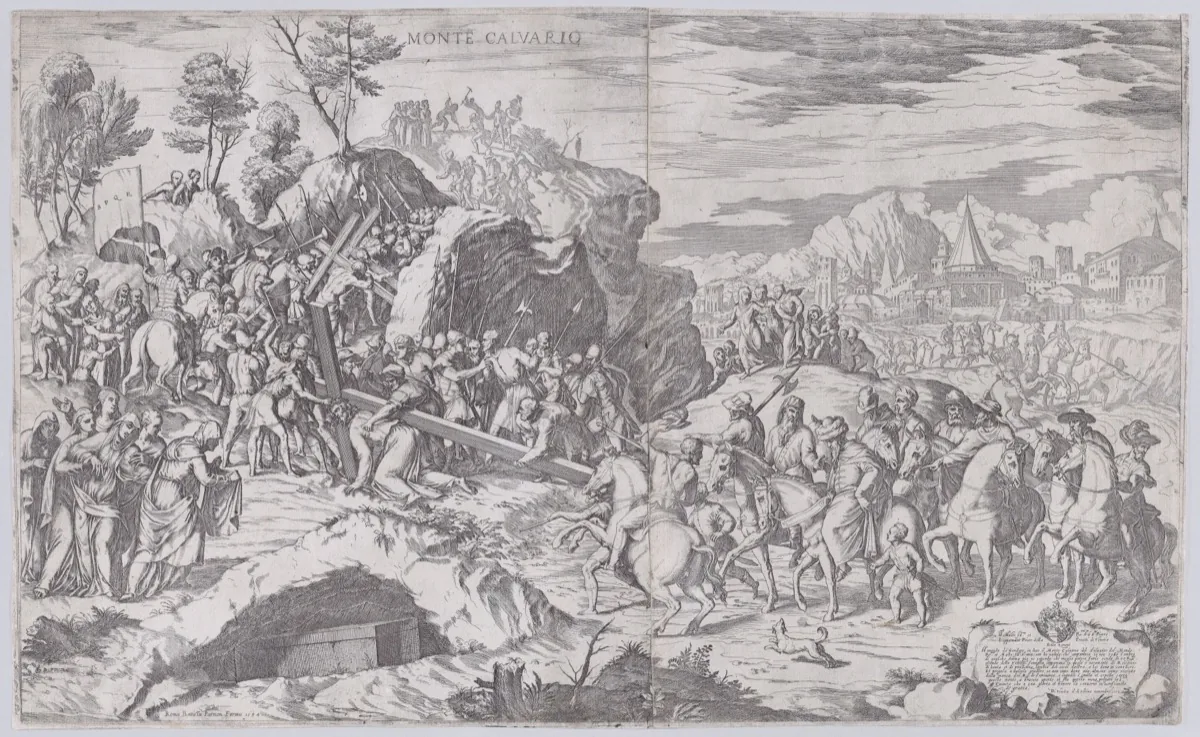
Station 3: Jesus falls the first time - Fontana etching of Christ falling under the cross
Christ falling on the road to Calvary by Giovanni Battista Fontana, ca. 1560-73. Etching and engraving. Metropolitan Museum of Art (Public Domain / CC0)

Traditional devotion (not directly in Scripture)

V.We adore You, O Christ, and we bless You.

R.Because by Your holy Cross You have redeemed the world.

Consider

Consider this first fall of Jesus under His Cross. His flesh was torn by the scourges, His head crowned with thorns, and He had lost a great quantity of blood. He was so weakened that He could scarcely walk, and yet He had to carry this great load upon His shoulders. The soldiers struck Him rudely, and thus He fell several times in His journey.

Prayer

My beloved Jesus, it is not the weight of the Cross, but my sins, which have made You suffer so much pain. By the merits of this first fall, deliver me from the misfortune of falling into mortal sin. I love You, O my Jesus, with my whole heart; I repent of having offended You. Never permit me to offend You again. Grant that I may love You always; and then do with me what You will.

Our Father. Hail Mary. Glory be to the Father.

Stabat Mater

O quam tristis et afflicta Fuit illa benedicta Mater Unigeniti!

O, how sad, and sore distressed, Now was she, that Mother Blessed Of the sole-begotten One.

Read full meditation for Station III
IV

Station IV

Jesus Meets His Mother

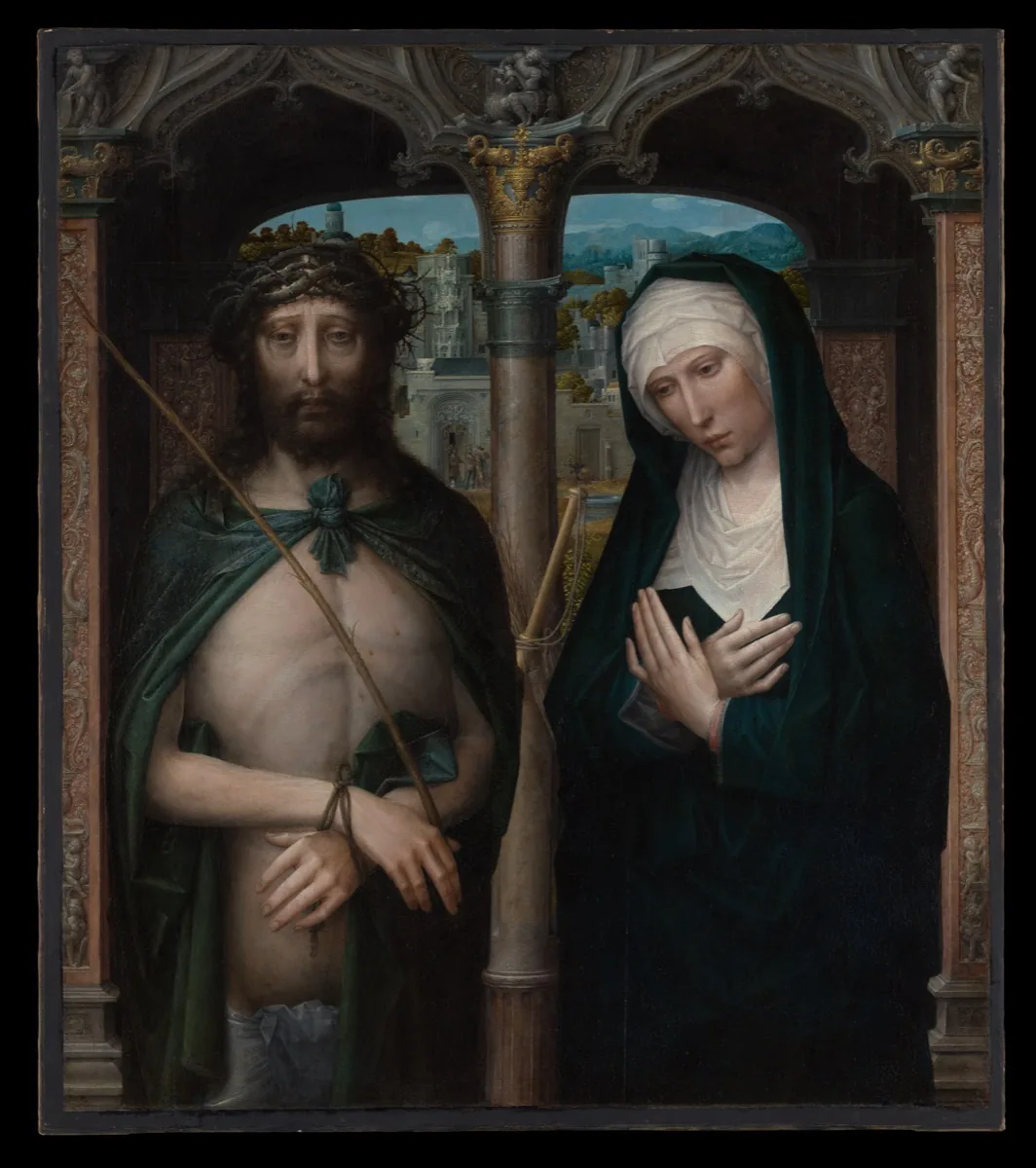
Station 4: Jesus meets His mother - Isenbrant painting of Christ and the Mourning Virgin
Christ Crowned with Thorns (Ecce Homo), and the Mourning Virgin by Adriaen Isenbrant, ca. 1530-40. Oil on canvas, transferred from wood. Metropolitan Museum of Art (Public Domain / CC0)

John 19:25-27; Luke 2:34-35

V.We adore You, O Christ, and we bless You.

R.Because by Your holy Cross You have redeemed the world.

Consider

Consider the meeting of the Son and the Mother, which took place on this journey. Their looks became as so many arrows to wound those hearts which loved each other so tenderly.

Prayer

My most loving Jesus, by the sorrow You experienced in this meeting, grant me the grace of a truly devoted love for Your most holy Mother. And you, my Queen, who was overwhelmed with sorrow, obtain for me by your intercession a continual and tender remembrance of the Passion of your Son. I love You, Jesus my love; I repent of having offended You. Never permit me to offend You again. Grant that I may love You always; and then do with me what You will.

Our Father. Hail Mary. Glory be to the Father.

Stabat Mater

Quae moerebat et dolebat, Pia Mater, dum videbat Nati poenas incliti.

Christ above in torment hangs; She beneath beholds the pangs Of her dying, glorious Son.

Read full meditation for Station IV
V

Station V

Simon of Cyrene Helps Jesus Carry the Cross

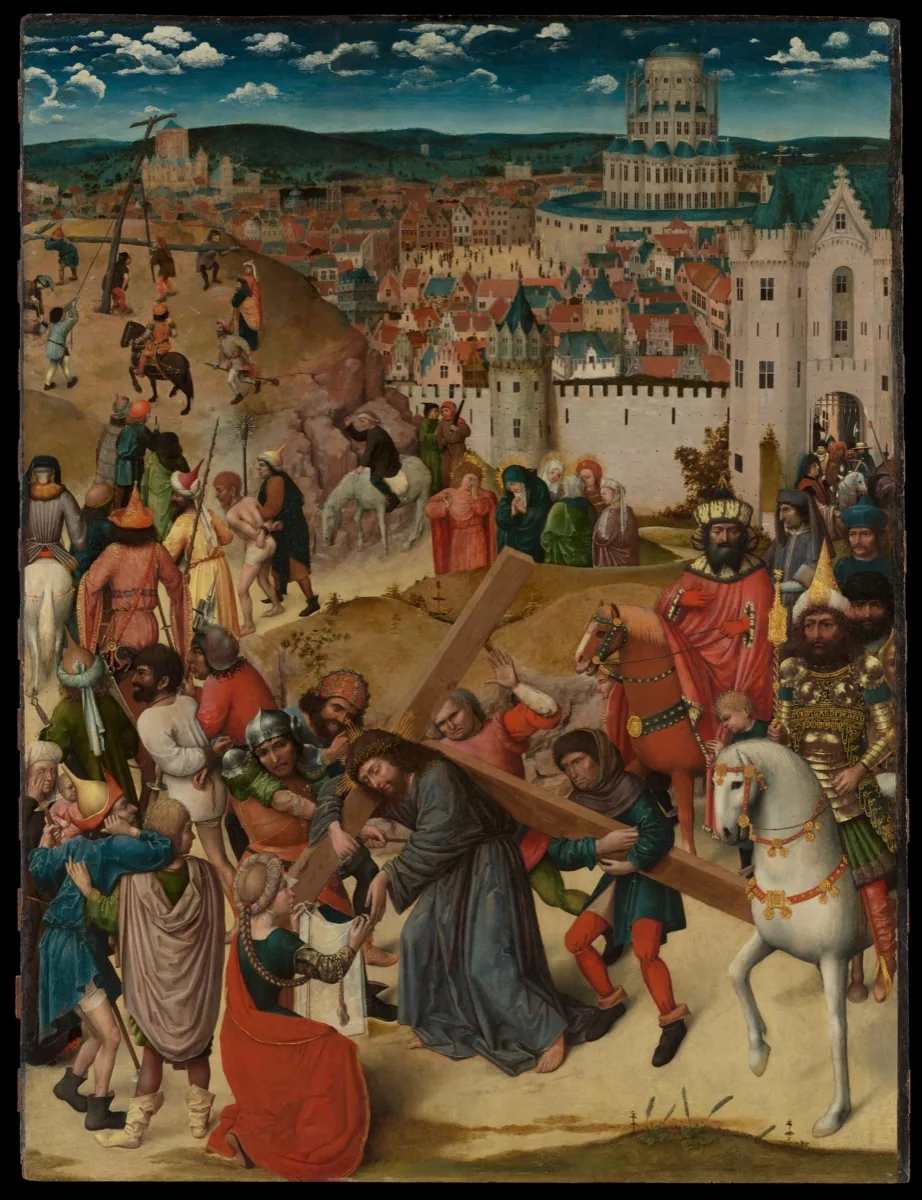
Station 5: Simon of Cyrene helps Jesus carry the cross - 15th century Netherlandish painting
Christ Bearing the Cross by North Netherlandish Painter, ca. 1470. Oil on wood. Metropolitan Museum of Art (Public Domain / CC0)

Matthew 27:32; Mark 15:21; Luke 23:26

V.We adore You, O Christ, and we bless You.

R.Because by Your holy Cross You have redeemed the world.

Consider

Consider how, seeing that at each step Jesus, from weakness, was on the point of expiring, the soldiers compelled Simon of Cyrene to carry the Cross behind Our Lord.

Prayer

My sweetest Jesus, I will not refuse the Cross; I accept it, I embrace it. I accept in particular the death You have destined for me, with all the pains that may accompany it; I unite it to Your death, I offer it to You. You have died for love of me; I will die for love of You and to please You. Help me by Your grace. I love You, Jesus my love; I repent of having offended You. Never permit me to offend You again. Grant that I may love You always; and then do with me what You will.

Our Father. Hail Mary. Glory be to the Father.

Stabat Mater

Quis est homo qui non fleret, Matrem Christi si videret In tanto supplicio?

Who, on Christ's dear Mother gazing, Pierced by anguish so amazing, Born of woman, would not weep?

Read full meditation for Station V
VI

Station VI

Veronica Wipes the Face of Jesus

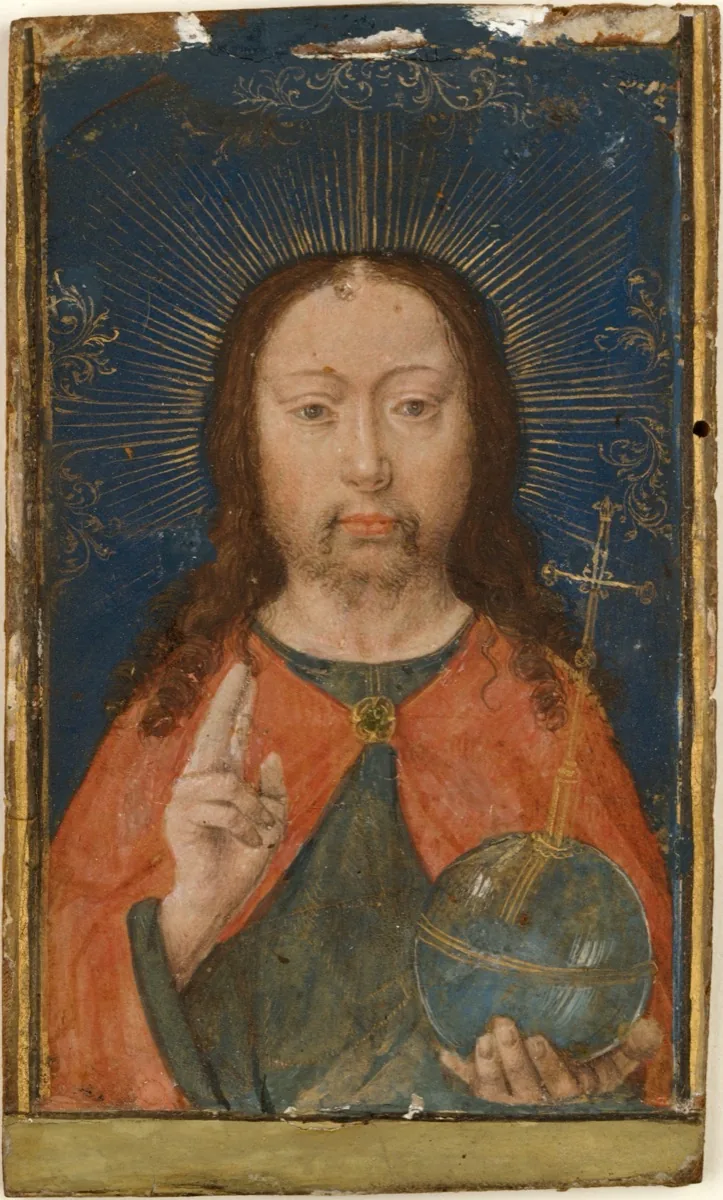
Station 6: Veronica wipes the face of Jesus - Gerard David painting of the Holy Face
Holy Face by Gerard David, ca. 1485-90. Tempera and gold leaf on parchment, on walnut. Metropolitan Museum of Art (Public Domain / CC0)

Traditional devotion (not directly in Scripture)

V.We adore You, O Christ, and we bless You.

R.Because by Your holy Cross You have redeemed the world.

Consider

Consider how the holy woman named Veronica, seeing Jesus so afflicted, and His face bathed in sweat and blood, presented Him with a towel, with which He wiped His adorable face, leaving on it the impression of His holy countenance.

Prayer

My beloved Jesus, Your face was beautiful before, but in this journey it has lost all its beauty, and wounds and blood have disfigured it. Alas, my soul also was once beautiful, when it received Your grace in Baptism; but I have disfigured it since by my sins. You alone, my Redeemer, can restore it to its former beauty. Do this by Your Passion, O Jesus. I love You, Jesus my love; I repent of having offended You. Never permit me to offend You again. Grant that I may love You always; and then do with me what You will.

Our Father. Hail Mary. Glory be to the Father.

Stabat Mater

Quis non posset contristari, Christi Matrem contemplari Dolentem cum Filio?

Who, on Christ's dear Mother thinking, Such a cup of sorrow drinking, Would not share her sorrow deep?

Read full meditation for Station VI
VII

Station VII

Jesus Falls the Second Time

Station 7: Jesus falls the second time - Jan Gossart painting of Christ stumbling under the cross
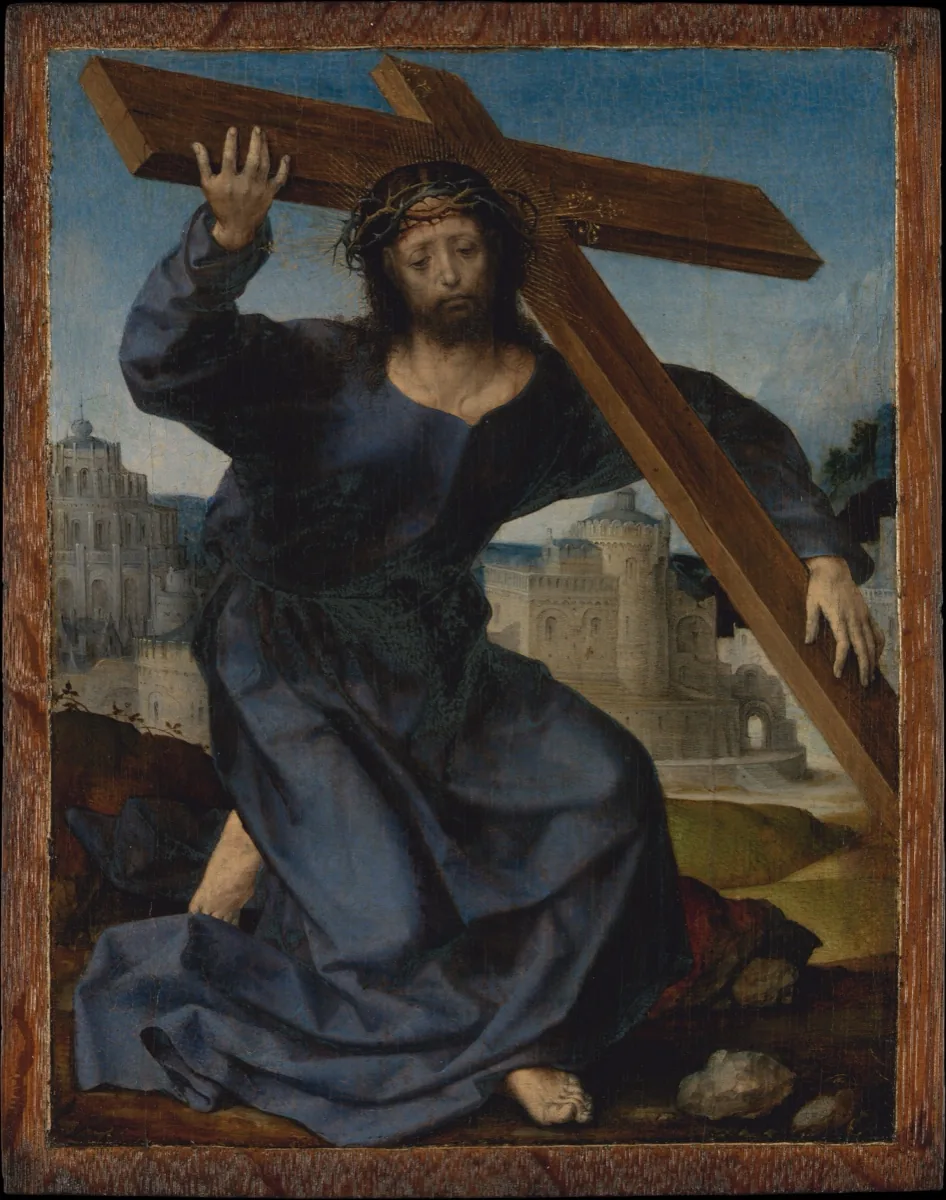
Christ Carrying the Cross by Jan Gossart (called Mabuse), ca. 1520-25. Oil on oak. Metropolitan Museum of Art (Public Domain / CC0)

Traditional devotion (not directly in Scripture)

V.We adore You, O Christ, and we bless You.

R.Because by Your holy Cross You have redeemed the world.

Consider

Consider the second fall of Jesus under the Cross, a fall which renews the pain of all the wounds of the head and members of our afflicted Lord.

Prayer

My most gentle Jesus, how many times You have pardoned me, and how many times have I fallen again, and begun again to offend You! Oh, by the merits of this new fall, give me the necessary help to persevere in Your grace until death. Grant that in all temptations which assail me I may always commend myself to You. I love You, Jesus my love, with my whole heart; I repent of having offended You. Never permit me to offend You again. Grant that I may love You always; and then do with me what You will.

Our Father. Hail Mary. Glory be to the Father.

Stabat Mater

Vidit suum dulcem Natum Moriendo desolatum, Dum emisit spiritum.

For the sins of His own nation, Saw Him hang in desolation, Till His spirit forth He sent.

Read full meditation for Station VII
VIII

Station VIII

Jesus Consoles the Women of Jerusalem

Station 8: Jesus meets the women of Jerusalem - Schongauer engraving of the procession to Golgotha
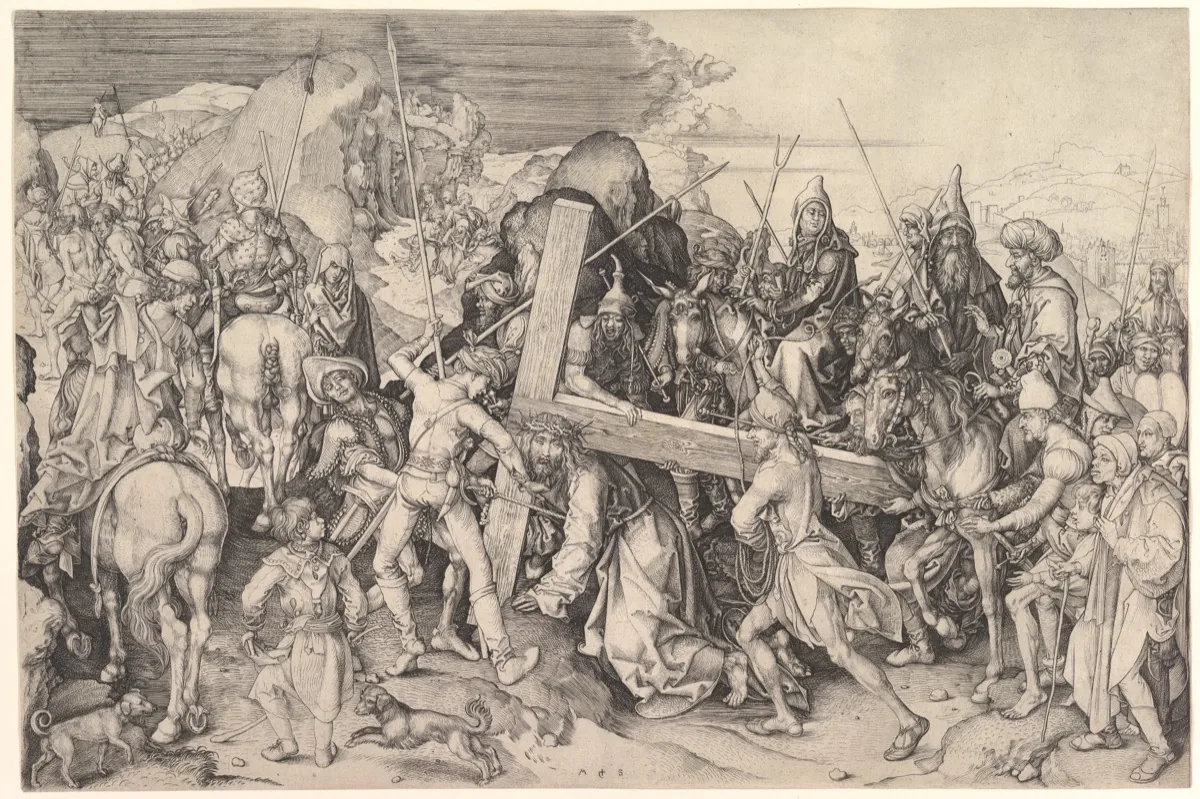
Christ Carrying the Cross by Martin Schongauer, ca. 1475-80. Engraving. Metropolitan Museum of Art (Public Domain / CC0)

Luke 23:27-31

V.We adore You, O Christ, and we bless You.

R.Because by Your holy Cross You have redeemed the world.

Consider

Consider how those women wept with compassion at seeing Jesus in such a pitiable state, streaming with blood, as He walked along. But Jesus said to them: "Weep not for Me, but for yourselves and for your children."

Prayer

My Jesus, laden with sorrows, I weep for the offenses I have committed against You, because of the pains they have deserved, and still more because of the displeasure they have caused You who have loved me so much. It is Your love, more than the fear of hell, that causes me to weep for my sins. My Jesus, I love You more than myself; I repent of having offended You. Never permit me to offend You again. Grant that I may love You always; and then do with me what You will.

Our Father. Hail Mary. Glory be to the Father.

Stabat Mater

Eia, Mater, fons amoris, Me sentire vim doloris Fac, ut tecum lugeam.

O thou Mother! fount of love! Touch my spirit from above, Make my heart with thine accord.

Read full meditation for Station VIII
IX

Station IX

Jesus Falls the Third Time

Station 9: Jesus falls the third time - Durer woodcut of Christ bearing the cross
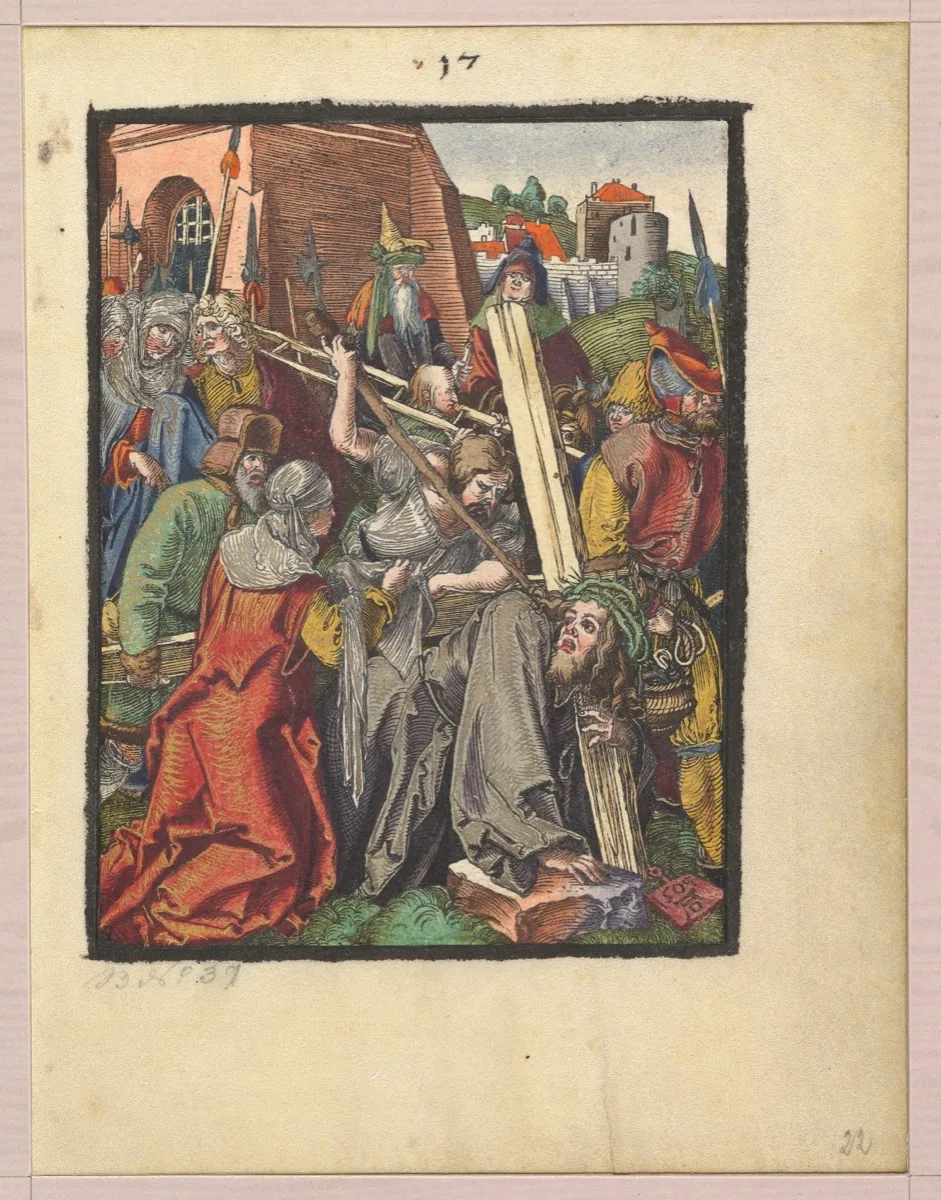
The Bearing of the Cross by Albrecht Durer, 1509-10. Hand-colored woodcut. Metropolitan Museum of Art (Public Domain / CC0)

Traditional devotion (not directly in Scripture)

V.We adore You, O Christ, and we bless You.

R.Because by Your holy Cross You have redeemed the world.

Consider

Consider the third fall of Jesus Christ. His weakness was extreme, and the cruelty of His executioners excessive, who tried to hasten His steps when He had scarcely the strength to move.

Prayer

Ah, my outraged Jesus, by the merits of the weakness You suffered in going to Calvary, give me strength sufficient to conquer all human respect, and all my wicked passions, which have led me to despise Your friendship. I love You, Jesus my love, with my whole heart; I repent of having offended You. Never permit me to offend You again. Grant that I may love You always; and then do with me what You will.

Our Father. Hail Mary. Glory be to the Father.

Stabat Mater

Fac ut ardeat cor meum In amando Christum Deum, Ut sibi complaceam.

Make me feel as thou hast felt; Make my soul to glow and melt With the love of Christ my Lord.

Read full meditation for Station IX
X

Station X

Jesus Is Stripped of His Garments

Station 10: Jesus is stripped of His garments - Engebrechtsz painting of the disrobing of Christ
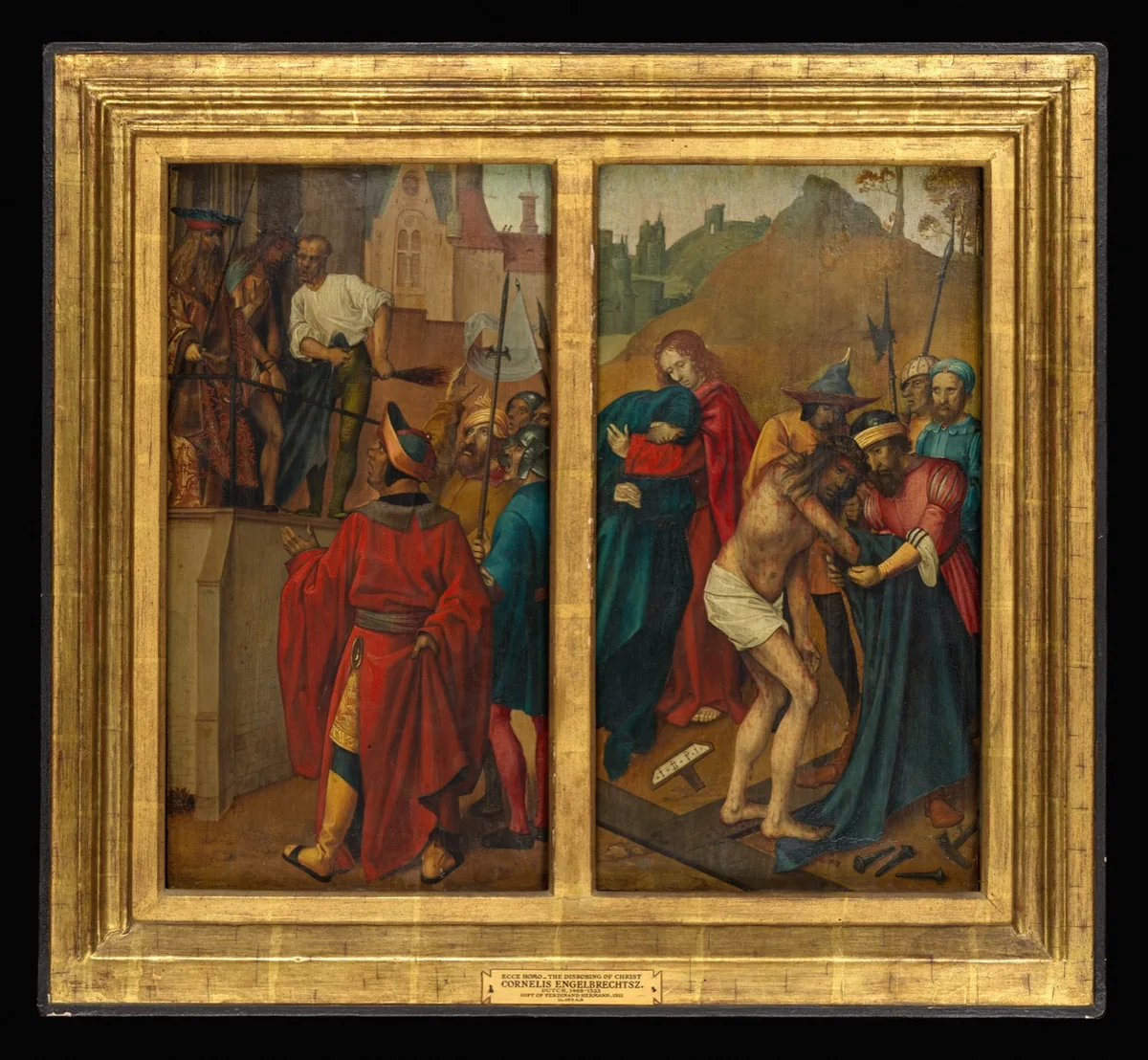
The Disrobing of Christ by Workshop of Cornelis Engebrechtsz, ca. 1505-10. Oil on wood. Metropolitan Museum of Art (Public Domain / CC0)

Matthew 27:35; Mark 15:24; Luke 23:34; John 19:23-24

V.We adore You, O Christ, and we bless You.

R.Because by Your holy Cross You have redeemed the world.

Consider

Consider the violence with which the executioners stripped Jesus. His inner garments adhered to His torn flesh, and they dragged them off so roughly that the skin came with them. Compassionate your Savior thus cruelly treated, and say to Him:

Prayer

My innocent Jesus, by the merits of the torment You felt, help me to strip myself of all affection to things of earth, in order that I may place all my love in You, who are so worthy of my love. I love You, O Jesus, with my whole heart; I repent of having offended You. Never permit me to offend You again. Grant that I may love You always; and then do with me what You will.

Our Father. Hail Mary. Glory be to the Father.

Stabat Mater

Sancta Mater, istud agas, Crucifixi fige plagas Cordi meo valide.

Holy Mother! pierce me through; In my heart each wound renew Of my Savior crucified.

Read full meditation for Station X
XI

Station XI

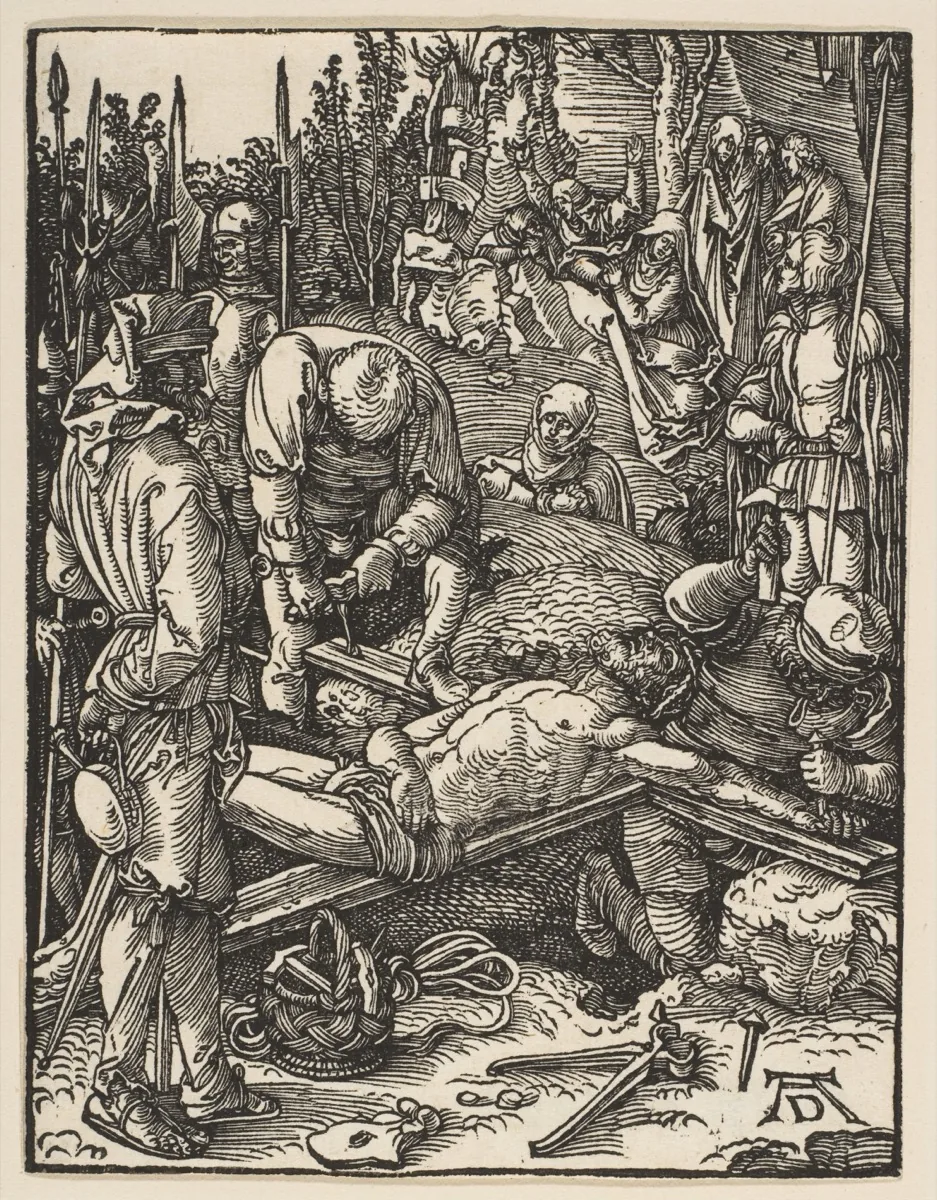
Jesus Is Nailed to the Cross

Station 11: Jesus is nailed to the cross - Durer woodcut of the Crucifixion
Christ Nailed to the Cross by Albrecht Durer, ca. 1509. Woodcut. Metropolitan Museum of Art (Public Domain / CC0)

Matthew 27:35-38; Mark 15:24-27; Luke 23:33; John 19:18

V.We adore You, O Christ, and we bless You.

R.Because by Your holy Cross You have redeemed the world.

Consider

Consider how Jesus, after being thrown on the Cross, extended His hands, and offered to His Eternal Father the sacrifice of His life for our salvation. These barbarians fastened Him with nails, and then, raising the Cross, allowed Him to die with anguish on this infamous gibbet.

Prayer

My Jesus! loaded with contempt, nail my heart to Your feet, that it may ever remain there, to love You and never quit You again. I love You more than myself; I repent of having offended You. Never permit me to offend You again. Grant that I may love You always; and then do with me what You will.

Our Father. Hail Mary. Glory be to the Father.

Stabat Mater

Iuxta crucem tecum stare, Et me tibi sociare In planctu desidero.

Let me mingle tears with thee, Mourning Him who mourned for me, All the days that I may live.

Read full meditation for Station XI
XII

Station XII

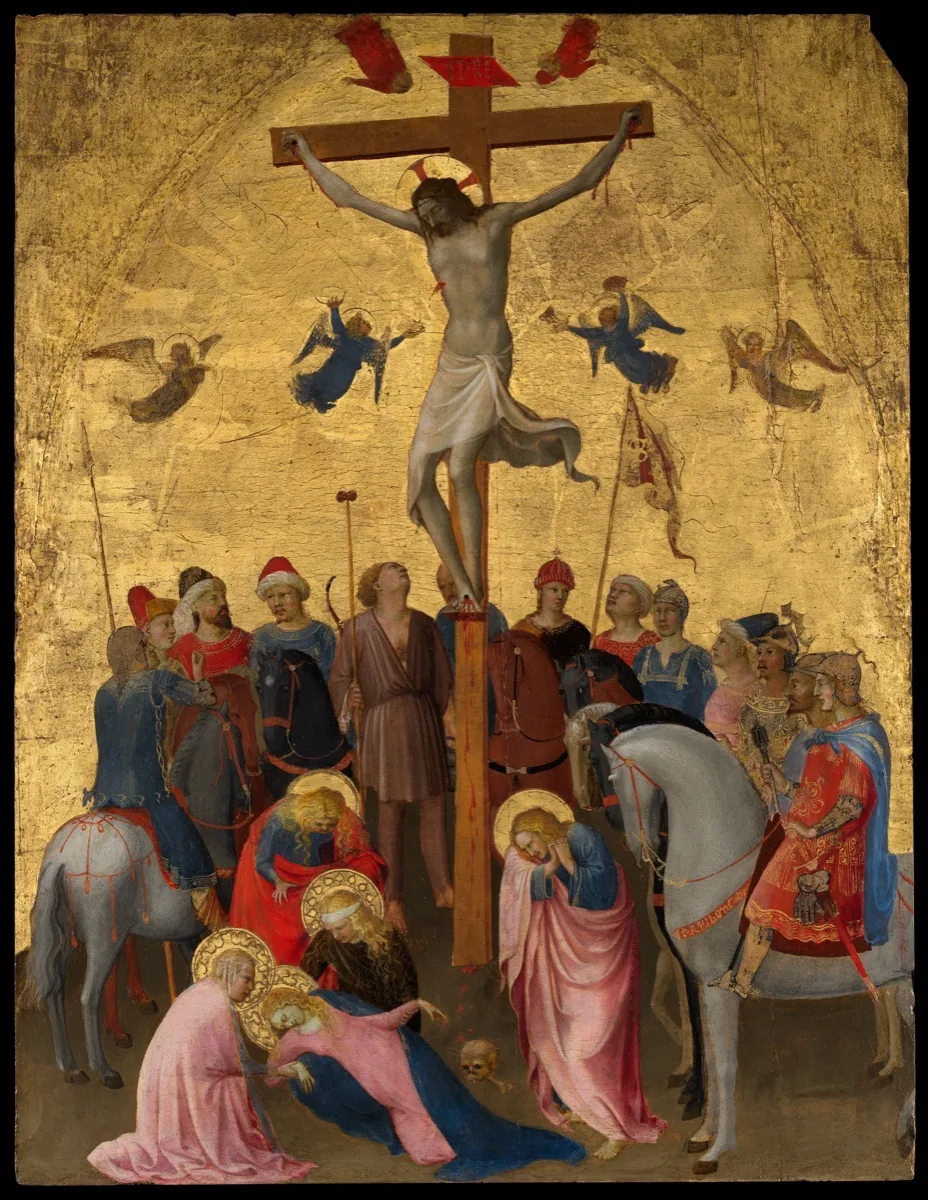
Jesus Dies on the Cross

Station 12: Jesus dies on the cross - Fra Angelico painting of the Crucifixion
The Crucifixion by Fra Angelico, ca. 1420-23. Tempera on wood, gold ground. Metropolitan Museum of Art (Public Domain / CC0)

Matthew 27:45-50; Mark 15:33-37; Luke 23:44-46; John 19:28-30

V.We adore You, O Christ, and we bless You.

R.Because by Your holy Cross You have redeemed the world.

Consider

Consider how your Jesus, after three hours of agony on the Cross, consumed at length with anguish, abandoned Himself to the weight of His body, bowed His head, and died.

Prayer

My dying Jesus, I kiss devoutly the Cross on which You died for love of me. I have merited by my sins to die a miserable death; but Your death is my hope. Ah, by the merits of Your death, give me grace to die, embracing Your feet and burning with love for You. I commit my soul into Your hands. I love You with my whole heart; I repent of having offended You. Never permit me to offend You again. Grant that I may love You always; and then do with me what You will.

Our Father. Hail Mary. Glory be to the Father.

Stabat Mater

Tui Nati vulnerati, Tam dignati pro me pati, Poenas mecum divide.

Wounded with His every wound, Steep my soul till it hath swooned In His very Blood away.

Read full meditation for Station XII
XIII

Station XIII

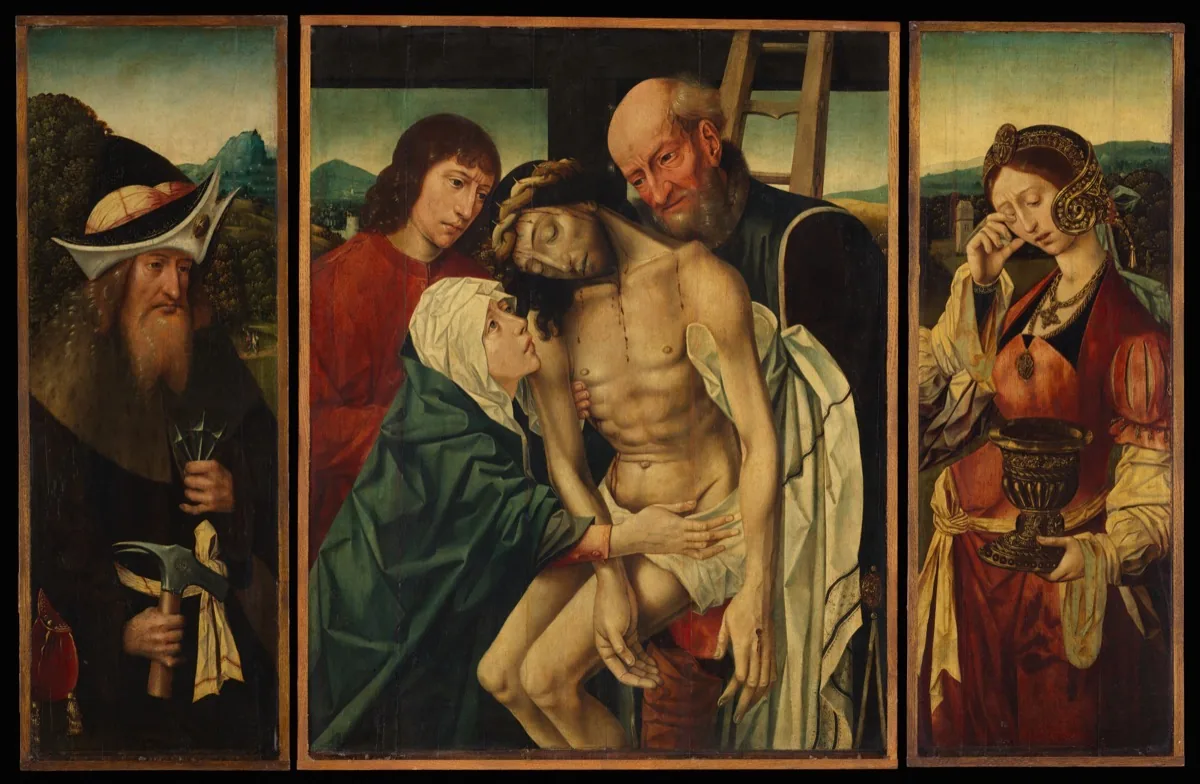
Jesus Is Taken Down from the Cross

Station 13: Jesus is taken down from the cross - Master of the Holy Blood triptych of the Deposition
The Descent from the Cross by Master of the Holy Blood, ca. 1520. Oil on wood. Metropolitan Museum of Art (Public Domain / CC0)

Matthew 27:57-59; Mark 15:42-46; Luke 23:50-53; John 19:38-40

V.We adore You, O Christ, and we bless You.

R.Because by Your holy Cross You have redeemed the world.

Consider

Consider how, after the death of our Lord, two of His disciples, Joseph and Nicodemus, took Him down from the Cross, and placed Him in the arms of His afflicted Mother, who received Him with unutterable tenderness, and pressed Him to her bosom.

Prayer

O Mother of Sorrow, for the love of this Son, accept me for your servant, and pray to Him for me. And You, my Redeemer, since You have died for me, permit me to love You; for I wish but You, and nothing more. I love You, my Jesus, and I repent of having offended You. Never permit me to offend You again. Grant that I may love You always; and then do with me what You will.

Our Father. Hail Mary. Glory be to the Father.

Stabat Mater

Fac me tecum pie flere, Crucifixo condolere, Donec ego vixero.

Be to me, O Virgin, nigh, Lest in flames I burn and die, In His awful Judgment Day.

Read full meditation for Station XIII
XIV

Station XIV

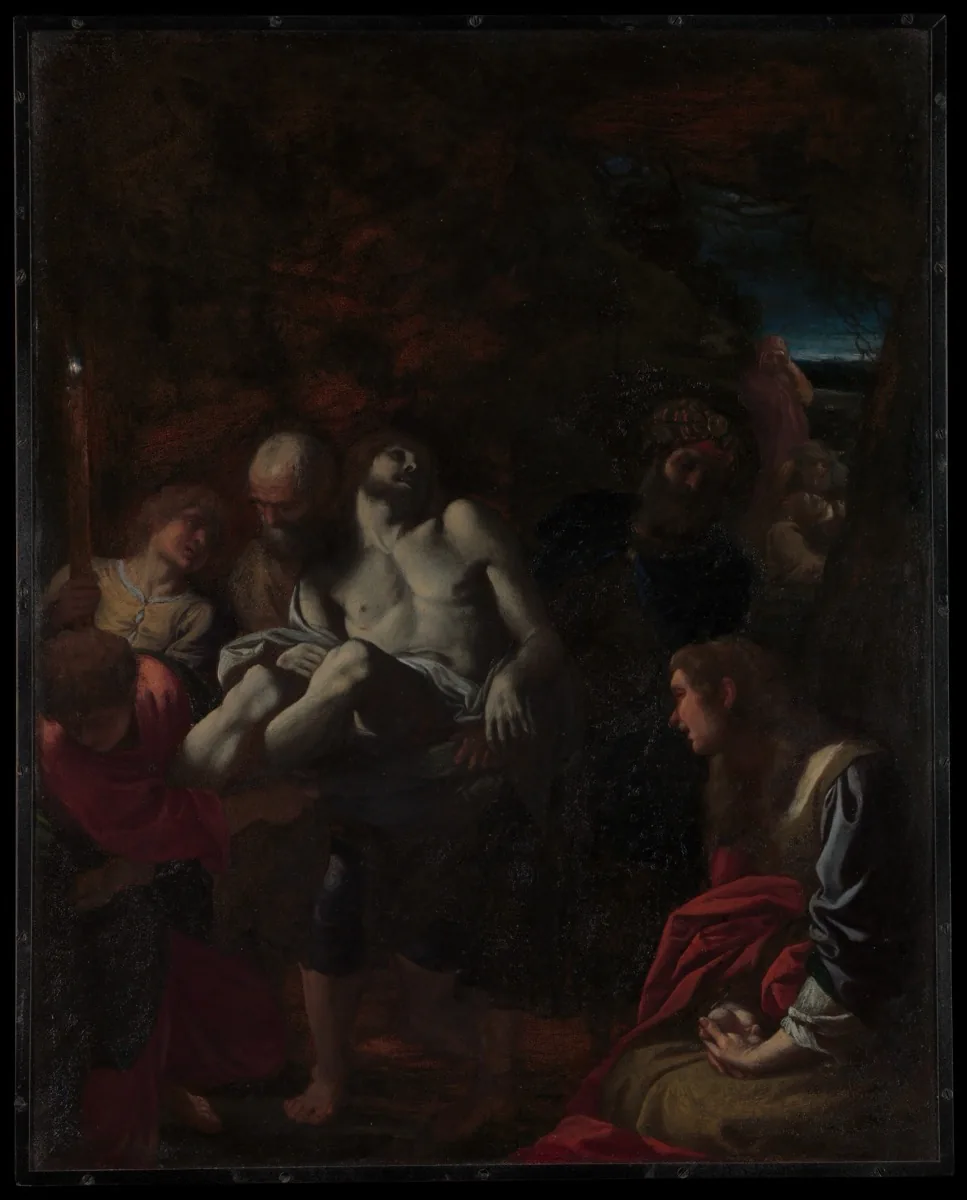
Jesus Is Laid in the Tomb

Station 14: Jesus is laid in the tomb - Annibale Carracci painting of the Entombment
The Burial of Christ by Annibale Carracci, 1595. Oil on copper. Metropolitan Museum of Art (Public Domain / CC0)

Matthew 27:59-60; Mark 15:46; Luke 23:53; John 19:41-42

V.We adore You, O Christ, and we bless You.

R.Because by Your holy Cross You have redeemed the world.

Consider

Consider how the disciples carried the body of Jesus to bury it, accompanied by His holy Mother, who arranged it in the sepulchre with her own hands. They then closed the tomb, and all withdrew.

Prayer

Oh, my buried Jesus, I kiss the stone that encloses You. But You did rise again the third day. I beseech You, by Your Resurrection, make me rise glorious with You at the last day, to be ever united with You in heaven, to praise and love You forever. I love You, and I repent of having offended You. Never permit me to offend You again. Grant that I may love You always; and then do with me what You will.

Our Father. Hail Mary. Glory be to the Father.

Stabat Mater

Quando corpus morietur, Fac ut animae donetur Paradisi gloria. Amen.

When my body here decayeth, Let my soul, Thy goodness stayeth, Dwell forever in Thy love. Amen.

Read full meditation for Station XIV

Closing Prayer

After the Stations, say the Our Father, the Hail Mary, and the Glory be to the Father, five times, in honor of the Passion of Jesus Christ, and once for the intention of the Holy Father.

Lord Jesus Christ, Your Passion and Death is the sacrifice that unites earth and heaven and reconciles all people to You. May we who have faithfully reflected on these mysteries follow in Your steps and so come to share Your glory in heaven, where You live and reign with the Father and the Holy Spirit, one God, for ever and ever. Amen.

Prayer Before a Crucifix (En Ego)

This prayer is traditionally said after the Stations of the Cross. A plenary indulgence is granted when recited before an image of Christ crucified after receiving Communion.

Behold, O kind and most sweet Jesus, I cast myself on my knees in Your sight, and with the most fervent desire of my soul, I pray and beg You to impress upon my heart lively sentiments of faith, hope, and charity, with true repentance for my sins, and a firm desire of amendment, while with deep affection and grief of soul I ponder within myself and mentally contemplate Your five most precious Wounds; having before my eyes that which David spoke in prophecy: "They pierced My hands and My feet; they have numbered all My bones."

How to Pray the Stations of the Cross

1. Begin with the Sign of the Cross and the Preparatory Prayer. Stand before the first station. Make the Sign of the Cross and recite the Preparatory Prayer.

2. Genuflect and pray the Versicle and Response. "We adore You, O Christ, and we bless You" / "Because by Your holy Cross You have redeemed the world."

3. Read the "Consider" meditation. Each station has a brief Liguori passage placing you in the scene.

4. Recite the station prayer. Each prayer applies the meaning of that station to your spiritual life.

5. Pray the Our Father, Hail Mary, and Glory Be.

6. Sing or recite a verse of the Stabat Mater while moving to the next station.

7. After the 14th station, pray the Closing Prayers and the En Ego.

Duration: 30 to 45 minutes with Stabat Mater; 20 to 25 minutes without.

The Stabat Mater

The Stabat Mater Dolorosa ("The Sorrowful Mother Stood") is a 13th-century Catholic hymn attributed to the Franciscan friar Jacopone da Todi (c. 1230-1306). It meditates on the suffering of Mary, the mother of Jesus, as she stood at the foot of the Cross.

The hymn has 20 three-line stanzas (tercets). In the Stations of the Cross, one stanza is sung or recited between each station, so that the hymn unfolds verse by verse across the entire devotion. The first 14 stanzas correspond to the 14 stations.

The Stabat Mater is one of the most-set texts in Western music, with settings by Palestrina, Vivaldi, Pergolesi, Haydn, Rossini, Dvorak, Verdi, and Arvo Part, among many others.

Full Text (Latin and English)

Stabat Mater dolorosa Iuxta crucem lacrimosa, Dum pendebat Filius.

At the Cross her station keeping, Stood the mournful Mother weeping, Close to Jesus to the last.

Cuius animam gementem, Contristatam et dolentem, Pertransivit gladius.

Through her heart, His sorrow sharing, All His bitter anguish bearing, Lo! the piercing sword had passed!

O quam tristis et afflicta Fuit illa benedicta Mater Unigeniti!

O, how sad, and sore distressed, Now was she, that Mother Blessed Of the sole-begotten One.

Quae moerebat et dolebat, Pia Mater, dum videbat Nati poenas incliti.

Christ above in torment hangs; She beneath beholds the pangs Of her dying, glorious Son.

Quis est homo qui non fleret, Matrem Christi si videret In tanto supplicio?

Who, on Christ's dear Mother gazing, Pierced by anguish so amazing, Born of woman, would not weep?

Quis non posset contristari, Christi Matrem contemplari Dolentem cum Filio?

Who, on Christ's dear Mother thinking, Such a cup of sorrow drinking, Would not share her sorrow deep?

Vidit suum dulcem Natum Moriendo desolatum, Dum emisit spiritum.

For the sins of His own nation, Saw Him hang in desolation, Till His spirit forth He sent.

Eia, Mater, fons amoris, Me sentire vim doloris Fac, ut tecum lugeam.

O thou Mother! fount of love! Touch my spirit from above, Make my heart with thine accord.

Fac ut ardeat cor meum In amando Christum Deum, Ut sibi complaceam.

Make me feel as thou hast felt; Make my soul to glow and melt With the love of Christ my Lord.

Sancta Mater, istud agas, Crucifixi fige plagas Cordi meo valide.

Holy Mother! pierce me through; In my heart each wound renew Of my Savior crucified.

Iuxta crucem tecum stare, Et me tibi sociare In planctu desidero.

Let me mingle tears with thee, Mourning Him who mourned for me, All the days that I may live.

Tui Nati vulnerati, Tam dignati pro me pati, Poenas mecum divide.

Wounded with His every wound, Steep my soul till it hath swooned In His very Blood away.

Fac me tecum pie flere, Crucifixo condolere, Donec ego vixero.

Be to me, O Virgin, nigh, Lest in flames I burn and die, In His awful Judgment Day.

Quando corpus morietur, Fac ut animae donetur Paradisi gloria. Amen.

When my body here decayeth, Let my soul, Thy goodness stayeth, Dwell forever in Thy love. Amen.

History of the Stations of the Cross

Origins in Jerusalem (1st-4th Century)

The Stations of the Cross trace their origins to the earliest centuries of Christianity. From the very beginning, the faithful in Jerusalem venerated the sites associated with Christ's Passion by walking the route from the Praetorium (Pilate's judgment hall) to Golgotha (Calvary) and the Holy Sepulchre. The pilgrim Egeria (c. 381-384 AD) described Holy Week processions along this route in her travel diary, making her account one of the earliest written records of the devotion.

The Franciscans and the Holy Land (1342)

After the fall of Jerusalem to Saladin in 1187, access to the holy sites became intermittent. In 1342, Pope Clement VI appointed the Franciscan Order as official custodians of the Holy Land -- a role they hold to this day as the Custodia Terrae Sanctae. The Franciscans established a fixed route through Jerusalem's streets, marking the places where tradition held that specific events occurred during Christ's walk to Calvary.

Spread to Europe (15th-17th Century)

As pilgrimages to Jerusalem were expensive and dangerous, the Franciscans began reproducing the Via Dolorosa in European churches and outdoor settings. The Blessed Alvarez of Cordoba (d. 1430) erected one of the earliest known sets of outdoor stations in his Dominican friary near Cordoba, Spain. By the late 15th century, sets of stations began appearing in churches throughout Italy, France, and the Low Countries.

Fixing the Number at 14 (1731)

In 1686, Pope Innocent XI granted the Franciscans the right to erect stations in all their churches. In 1731, Pope Clement XII fixed the number at 14 and extended the privilege to all Catholic churches, provided the stations were erected by a Franciscan priest with the consent of the local bishop. The 14 stations as we know them today have remained unchanged since 1731.

St. Leonard of Port Maurice (1676-1751)

No one did more to spread the Stations of the Cross than St. Leonard of Port Maurice, a Franciscan priest who erected 571 sets of stations across Italy during his lifetime. His most famous erection was in the Roman Colosseum in 1750, where he was invited by Pope Benedict XIV. The Colosseum stations were removed in 1874 but restored by Pope Pius XI in 1926, and to this day the Pope leads the Way of the Cross there every Good Friday.

St. Alphonsus Liguori (1696-1787)

The most widely used meditations for the Stations are those composed by St. Alphonsus Maria de Liguori, Doctor of the Church, founder of the Redemptorists, and one of the most influential moral theologians in Catholic history. His text, first published in the mid-18th century, combines a "Consider" passage with a prayer ending: "Grant that I may love You always; and then do with me what You will." This text remains the standard in Catholic parishes worldwide and is the primary text used in this app.

The Scriptural Stations (1991)

In 1991, Pope St. John Paul II introduced the Scriptural Way of the Cross, in which every station is drawn directly from the Gospels. This version replaces stations that lack explicit scriptural support (such as the three falls and Veronica) with Gospel events (such as Gethsemane, Peter's denial, and the Good Thief). The Scriptural Stations are used at the Vatican's Good Friday service on alternating years.
Traditions of the Stations of the Cross

While the traditional 14 stations with Liguori's meditations are the most common, the Catholic tradition includes several variations, each offering a distinct spiritual lens on Christ's Passion:

The Plenary Indulgence

What Is a Plenary Indulgence?

A plenary indulgence removes all temporal punishment due to sin that has already been forgiven. In Catholic theology, the Sacrament of Confession forgives the guilt of sin, but there can still remain temporal effects or purification due to that sin. An indulgence remits that purification. A plenary indulgence means the whole debt is remitted, not just part of it.

If someone died immediately after receiving a plenary indulgence while properly disposed, they would not need purification in Purgatory.

How the Stations of the Cross Grant This Indulgence

According to the Enchiridion Indulgentiarum (the official handbook of indulgences issued by the Apostolic Penitentiary), a plenary indulgence is granted to the faithful who devoutly make the Way of the Cross. The requirements for the devotion itself are:

  • The stations must be legitimately erected (blessed by a priest with the faculty to do so).
  • 14 stations are required, with a cross at each.
  • The person must move from station to station (when done in a church) or follow a leader who moves.
  • Meditation on the Passion and death of the Lord is required; specific prayers are not mandated, though the Liguori meditations are traditional.

The Four Conditions for Any Plenary Indulgence

In addition to performing the indulgenced act (the Stations), four specific conditions must be fulfilled. These are established by the norms of the Apostolic Penitentiary:

1. Sacramental Confession

You must receive the Sacrament of Reconciliation. One confession can apply to multiple plenary indulgences. It should normally be within about 20 days before or after the indulgenced act. The purpose is to remove the guilt of sin so the indulgence can address the temporal punishment remaining.

2. Reception of Holy Communion

You must receive the Eucharist, ideally on the same day you perform the indulgenced work. Each plenary indulgence should have its own reception of Communion.

3. Prayer for the Intentions of the Pope

You must pray for the intentions of the Holy Father. Common practice is one Our Father and one Hail Mary, but any prayer suffices. You do not need to know the specific intentions.

4. Complete Detachment from Sin

This is the most difficult and most often missed condition. You must have complete detachment from all sin, even venial sin. This means you sincerely do not want any sin in your life, you are not intentionally holding on to a sinful habit, and your heart is oriented toward loving God above all things.

If this condition is not fully present, the indulgence becomes partial instead of plenary. A partial indulgence still remits some temporal punishment and is a great grace.

For Those Lawfully Hindered

The Church recognizes that some faithful cannot physically make the Stations of the Cross. Examples include illness, being homebound, imprisonment, caring for someone who cannot be left alone, or lack of access to a church with erected stations.

If someone is legitimately unable to make the Stations, they can receive the same plenary indulgence by reading and meditating on the Passion and Death of our Lord Jesus Christ for at least one half-hour. This means prayerfully reflecting on the suffering and death of Jesus, such as the Passion narratives in the Gospels of Matthew (chapters 26-27), Mark (chapters 14-15), Luke (chapters 22-23), or John (chapters 18-19).

The heart of the indulgence is uniting yourself with the suffering of Christ. The Church is saying: if you cannot physically walk the Stations, you can enter spiritually into Christ's Passion through meditation and receive the same spiritual benefit.

Offering for the Souls in Purgatory

You may offer any plenary indulgence for a soul in Purgatory rather than applying it to yourself. This reflects the doctrine of the Communion of Saints: the living and the dead remain united in Christ, and the merits of prayer and sacrifice can be shared across this bond.

If you have a loved one who has died, praying the Stations of the Cross and offering the indulgence for their soul is one of the most powerful acts of charity the Church places in your hands.

Disposing the Heart: A Brief Preparation

Saints and spiritual masters recommend a brief preparation before praying the Stations to help dispose the heart for "detachment from all sin." A simple practice:

  1. Examine your conscience briefly. Ask the Holy Spirit to show you any attachment to sin.
  2. Make an act of contrition. Tell God you are sorry and desire to love Him above all things.
  3. State your intention. Offer the devotion for yourself, for a soul in Purgatory, or for a specific grace.
  4. Ask for the grace of detachment. "Lord, I desire to be free from all attachment to sin. Grant me this grace."

In summary:

  • Pray the Stations of the Cross devoutly
  • Sacramental Confession (within ~20 days)
  • Receive Holy Communion
  • Pray for the intentions of the Holy Father
  • Be detached from all sin, even venial sin

If all five are present, a plenary indulgence is gained. If not, a partial indulgence is still received.

Those who devoutly make the Stations of the Cross may gain a plenary indulgence. Those who are lawfully hindered from making the Stations of the Cross may gain the same indulgence if they read and meditate on the Passion and Death of our Lord for at least one half-hour.

Prayers Used in the Stations of the Cross

Three common prayers are recited between each station. These are among the most fundamental prayers of the Catholic faith:

Our Father (Pater Noster)

Our Father, who art in heaven, hallowed be thy name. Thy kingdom come. Thy will be done, on earth as it is in heaven. Give us this day our daily bread, and forgive us our trespasses, as we forgive those who trespass against us. And lead us not into temptation, but deliver us from evil. Amen.

Hail Mary (Ave Maria)

Hail Mary, full of grace, the Lord is with thee. Blessed art thou amongst women, and blessed is the fruit of thy womb, Jesus. Holy Mary, Mother of God, pray for us sinners, now, and at the hour of our death. Amen.

Glory Be (Gloria Patri)

Glory be to the Father, and to the Son, and to the Holy Spirit. As it was in the beginning, is now, and ever shall be, world without end. Amen.

Pray the Stations Now

Walk the Way of the Cross with full prayers, meditations by St. Alphonsus Liguori, Stabat Mater, and audio narration. Free, beautiful, and faithful to the Catholic tradition.

Begin the Stations

Artwork Credits

All artwork is public domain (CC0) from the Metropolitan Museum of Art Open Access program. Artists: Rembrandt van Rijn, El Greco, Giovanni Battista Fontana, Adriaen Isenbrant, Gerard David, Petrus Christus, Martin Schongauer, Albrecht Durer, Cornelis Engebrechtsz, Fra Angelico, Master of the Holy Blood, and Annibale Carracci.